Sanity Check#
Energy and Angular momentum conservation#
Accurate long-term simulations in N-body dynamics hinge on the precise computation of forces and the integration of particle trajectories. One of the most fundamental validation steps in any N-body code is verifying the conservation of physical quantities—most importantly, total energy and angular momentum.
⚠️ Why Check for Conservation?#
In a system governed by Newtonian gravity or other time-independent conservative forces, total energy and angular momentum should be conserved over time. These quantities serve as diagnostic tools for numerical accuracy and physical consistency:
Total Energy conservation: in an isolated system the forces are conservative, the total mechanical energy (kinetic + potential) must remain constant.
Angular Momentum conservation: for systems with rotational symmetry (e.g., central potentials or disk galaxies), angular momentum must be conserved.
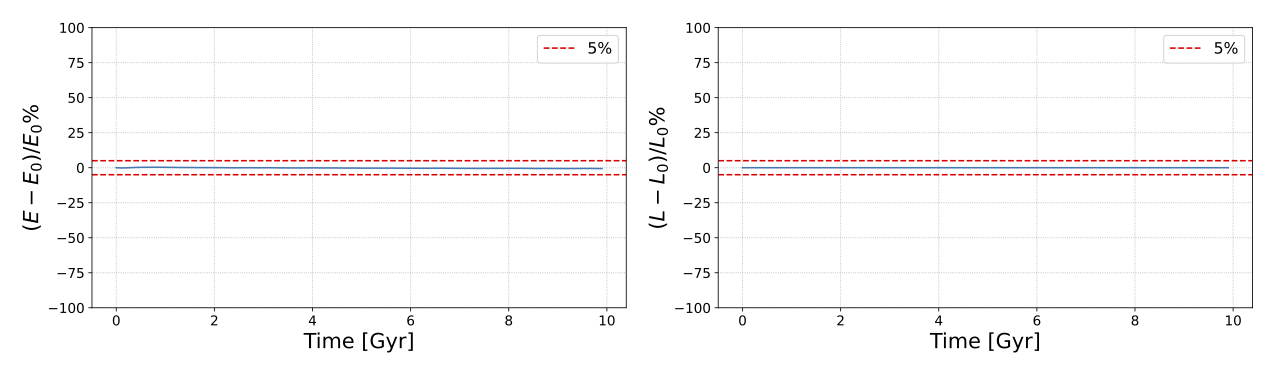
In order to access the conservation of quantities, in Odisseo the function energy_angular_momentum_plot is implemented to check the relative error (a minimal example is shown below) across the time steps as a post-processing operation.
Example#
from odisseo.option_classes import SimulationConfig
from odisseo.time_integration import time_integration
from odisseo.units import CodeUnits


code_length = 10.0 * u.kpc
code_mass = 1e8 * u.Msun
G = 1
code_units = CodeUnits(code_length, code_mass, G=G)

config = SimulationConfig(N_particles=10_000,
                          return_snapshots=True,                        #THE SNAPSHOTS NEED TO BE RETURNED
                          num_snapshots=100,                            #THE NUMBER OF SNAPSHOTS THAT ARE USED
                          num_timesteps=1_000,
                          external_accelerations=(MN_POTENTIAL,  ),
                          acceleration_scheme=DIRECT_ACC,
                          softening=(0.1 * u.kpc).to(code_units.code_length).value)

#### CODE TO RUN THE SIMULATION #####

snapshots = time_integration(initial_state, mass, config, params)
energy_angular_momentum_plot(snapshots,
                            code_units,                                                     #UNITS FOR CONVERSION
                            filename='./visualization/image/E_L_Plummer_in_MNpotential.pdf' #WHERE TO SAVE THE PLOT
                            )
An example of the previous function is shown below: